

An AI automation agency business model is a service-based business model where an agency helps companies automate business workflows using AI tools, AI agents, chatbots, CRM automation, API integrations, robotic process automation, and reporting dashboards. AI automation agency business model is one of the fastest-growing service models for entrepreneurs, consultants, and digital agencies entering the AI space. Instead of only selling websites, ads, or general software services, an AI automation agency helps businesses automate repetitive tasks, improve workflows, reduce manual work, and connect different tools into smarter systems.
This model is valuable because most companies do not just need AI tools. They need practical systems that solve real business problems, such as slow lead follow-up, manual reporting, missed appointments, repeated customer questions, and disconnected CRM data.
Why AI Automation Agencies Are Growing
AI automation agencies are growing because businesses are under pressure to work faster without increasing their operational costs. Many companies already use CRMs, email platforms, spreadsheets, ad platforms, chat tools, and project management software, but these tools often do not communicate properly with each other.
That creates gaps in daily operations. Leads are missed. Reports take hours. Customers wait too long for replies. Teams repeat the same tasks every day. An AI workflow automation agency solves these problems by connecting systems and using automation to move data, trigger actions, and support decision-making.
McKinsey’s 2025 AI research found that workflow redesign has the biggest effect on whether companies see measurable EBIT impact from generative AI, and only 21% of organizations using gen AI had fundamentally redesigned at least some workflows. This supports the core value of an AI automation agency: the real benefit comes from redesigning how work gets done, not only adding a new tool.
Real-World Examples of AI Automation in Business
The AI automation agency business model becomes easier to understand when it is connected to real business outcomes. Large companies are already showing how automation can improve customer support, HR operations, incident management, and service delivery.
Klarna reported that its AI assistant handled 2.3 million customer conversations in its first month, covering about two-thirds of customer service chats and doing work equivalent to 700 full-time agents. For AI automation agencies, this proves that customer support automation is one of the clearest use cases because it reduces repetitive conversations and improves response speed.
IBM’s AskHR example also shows how AI agents can support internal operations. IBM reported that AskHR contributed to a 40% reduction in HR operational costs over four years, achieved a 94% containment rate for common questions, and reduced support tickets by 75% since 2016. This is a strong example of how AI automation can be used beyond sales and marketing.
UiPath’s public automation examples show similar value in workflow improvement. Woolworths achieved 70% faster incident resolution with UiPath Process Mining, while One NZ reduced mobile provisioning from around 10 days to under 10 minutes using UiPath orchestration. These examples show why businesses pay for automation when it removes bottlenecks and speeds up operations.
For smaller agencies, these examples do not mean they need enterprise clients from day one. The same logic can be applied to local businesses. A clinic may need automated appointment reminders. A real estate company may need instant lead follow-up. A digital agency may need automated client reporting. An eCommerce store may need AI-driven customer support and order-update workflows.
How an AI Automation Agency Makes Money
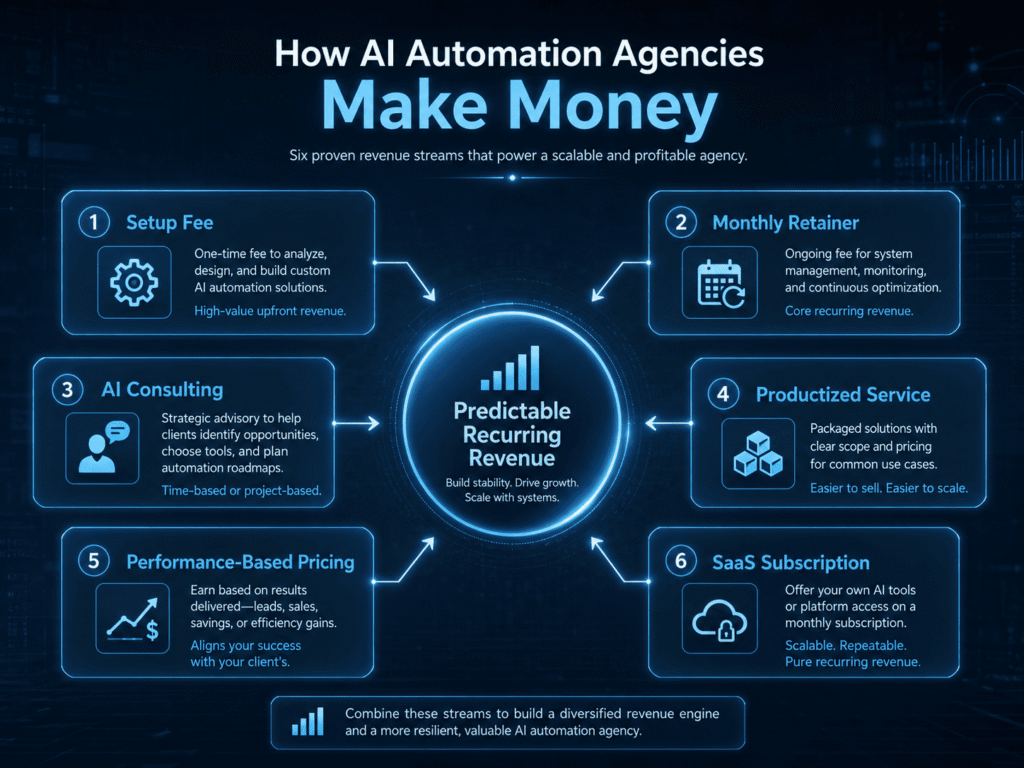
An AI automation agency can make money in several ways. Most agencies start with project-based services and later move toward monthly recurring revenue.
| Setup Fee | One-time payment to build an automation system | New clients and small projects |
| Monthly Retainer | Ongoing support, monitoring, and optimization | Long-term revenue |
| AI Consulting | Strategy, workflow audits, and automation planning | Businesses unsure where to start |
| Productized Service | Fixed package with clear scope and price | Scaling repeatable offers |
| Performance-Based Pricing | Payment linked to results such as leads or cost savings | Advanced agencies with tracking |
| SaaS-Style Subscription | Repeatable system sold as a monthly product | Agencies building scalable assets |
The strongest AI agency revenue model is usually a hybrid model. For example, an agency may charge a setup fee to build the system and then charge a monthly retainer for maintenance, reporting, optimization, and support.
Core Services in an AI Automation Agency
A strong AI automation agency should sell business outcomes, not just tools. Clients do not usually care whether the agency uses Zapier, Make, OpenAI, HubSpot, GoHighLevel, Salesforce, or custom APIs. They care about what the automation will do for their business.
AI Chatbots and Customer Support Automation
AI chatbots help businesses answer repeated questions, collect customer details, qualify leads, and reduce support workload. A basic chatbot only replies to questions. A stronger AI chatbot connects with CRM data, routes inquiries, creates tickets, and sends important conversations to human team members.
CRM and Sales Pipeline Automation
CRM automation helps sales teams respond faster and manage leads more clearly. An AI automation agency can build workflows that capture leads from forms, ads, WhatsApp, email, or calls and then automatically assign them to the right person.
This improves lead response time, reduces missed opportunities, and helps managers track the sales pipeline.
Workflow Automation and Robotic Process Automation
Workflow automation is the core of the AI automation agency model. It includes automating repetitive tasks such as data entry, invoice reminders, client onboarding, file organization, appointment confirmations, and task creation.
Robotic process automation can also help businesses move data between systems, process documents, and complete rule-based tasks faster.
AI Agents for Business Tasks
AI agents are becoming more important because they can complete multi-step tasks with less manual input. Gartner expects AI agents to move from a rare enterprise feature to a standard business tool by 2026, with task-specific agents appearing in up to 40% of enterprise applications, up from less than 5% today.
For agencies, this creates opportunities to build AI agents for lead qualification, customer service, internal research, appointment scheduling, reporting, HR support, and operations management.
AI Reporting Dashboards
Many businesses collect data from different platforms but do not have a clean way to understand it. An AI automation agency can build dashboards that pull data from Google Ads, Google Analytics, Meta Ads, Search Console, CRMs, spreadsheets, and sales tools.
This saves time and gives businesses clearer performance insights.
Client-Style Use Cases for an AI Automation Agency
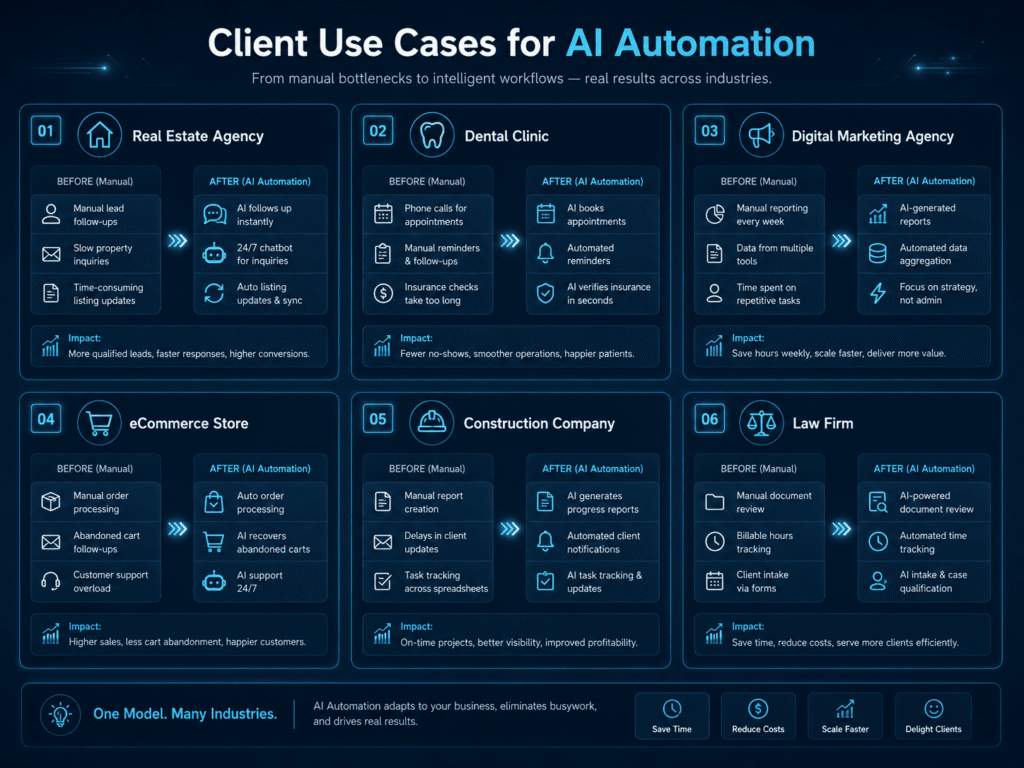
| Real Estate Agency | Leads are followed up late | AI lead qualification and CRM follow-up | Faster response and more booked calls |
| Dental Clinic | Staff answer repeated questions | AI chatbot and appointment reminders | Fewer missed appointments |
| Digital Marketing Agency | Reports take hours every week | AI reporting dashboard | Faster reporting and better retention |
| eCommerce Store | Support team repeats order answers | AI support assistant connected to order data | Lower support workload |
| Construction Company | Quote requests are handled manually | Automated inquiry and quote intake system | Cleaner lead tracking |
| Law Firm | Intake forms are slow and disorganized | AI intake workflow and consultation routing | Faster client qualification |
This makes the AI automation business model more practical because it connects services with real client problems.
Best Niches for an AI Automation Agency
Choosing a niche helps an agency position itself clearly. A general agency offering “AI solutions for everyone” may struggle because the message is too broad.
Strong niches include:
| Real Estate | Lead routing, inquiry follow-up, CRM updates |
| Medical Clinics | Appointment reminders, patient FAQs, intake forms |
| eCommerce | Customer support, order updates, abandoned cart workflows |
| Digital Agencies | Client reporting, onboarding, task automation |
| Construction | Quote requests, project updates, client communication |
| Law Firms | Intake forms, document workflows, consultation booking |
| Local Services | Call tracking, review requests, lead follow-up |
The most profitable agencies usually focus on one niche first, build repeatable workflows, and then scale with productized services.
AI Automation Agency Pricing Models
Pricing should depend on workflow complexity, business value, integrations, support level, and the amount of customization required.
| Starter Automation | Small businesses | One workflow, basic chatbot, simple integration |
| Growth Automation | Growing teams | CRM automation, follow-ups, reporting |
| Advanced Automation | Larger businesses | Multi-step workflows, AI agents, dashboards |
| Custom Enterprise | Complex operations | Custom integrations, governance, training |
New agencies often underprice because they charge only for time. A better approach is value-based pricing. If an automation saves a business dozens of hours every month or helps recover missed leads, the service has clear business value.
How to Build an AI Automation Agency Business Model Step by Step
Step 1: Choose a Clear Target Market
The agency should first decide who it serves. A focused agency can understand pain points better and create stronger offers.
Step 2: Identify Manual Work That Costs Time or Money
The best automation opportunities are tasks that are repetitive, slow, error-prone, or connected to revenue. Examples include missed leads, delayed follow-ups, manual reporting, repeated support questions, and poor appointment management.
Step 3: Create a Productized Offer
Instead of saying “AI automation services,” the agency should create a clear offer, such as:
AI Lead Follow-Up System for Real Estate Agencies
or
Automated Client Reporting System for Marketing Agencies
This makes the offer easier to understand and easier to sell.
Step 4: Build Repeatable Delivery Systems
A scalable agency needs SOPs, onboarding forms, testing checklists, workflow maps, templates, documentation, and client training materials. This improves delivery quality and reduces dependency on one person.
Step 5: Add Monthly Support
Automation is not a one-time job. Tools update, APIs change, workflows break, and client needs evolve. Monthly retainers help the agency create predictable revenue while keeping client systems reliable.
What Makes an AI Automation Agency Profitable?
Profitability depends on repeatability and retention. If every client requires a completely new system from scratch, the agency may struggle to scale. But if the agency serves one niche with similar workflows, it can reuse templates, onboarding processes, automation logic, and reporting structures.
A profitable AI automation agency usually has:
- Clear niche positioning
- Productized service packages
- Monthly recurring revenue
- Documented delivery process
- Strong client onboarding
- Clear ROI tracking
- Low tool complexity
- Good support systems
- Case studies and client proof
The agency should also collect measurable results. If a workflow saves 30 hours per month, reduces missed calls, or improves booked appointments, those numbers can become case study material.
How to Measure ROI in an AI Automation Agency Model
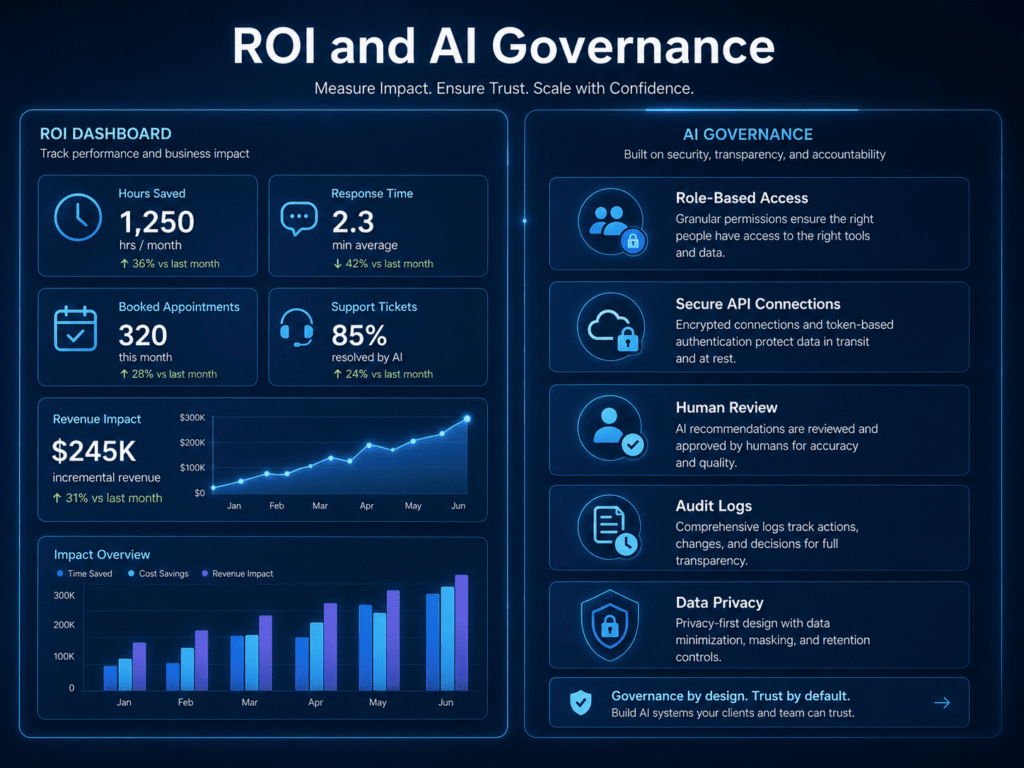
One way to make an AI automation agency more trustworthy is to measure results before and after implementation.
Important ROI metrics include:
- Hours saved per week
- Cost of manual work reduced
- Faster lead response time
- More booked appointments
- Fewer missed leads
- Lower support ticket volume
- Better reporting accuracy
- Shorter process completion time
- Higher customer satisfaction
A simple formula is:
Automation ROI = Value of time saved + extra revenue generated – automation cost
For example, if a business saves 40 admin hours per month and each hour costs $20, the time-saving value is $800 per month. If the same automation helps generate $1,500 in extra booked calls, the total monthly value becomes $2,300 before subtracting the automation cost.
Data Privacy, Human Review, and AI Governance
AI automation agencies often connect with sensitive systems such as CRMs, customer databases, email accounts, call records, payment tools, and internal documents. Because of this, responsible implementation is important.
A reliable agency should use:
- Role-based access
- Secure API connections
- Limited data permissions
- Human-in-the-loop review
- Clear approval workflows
- Backup and error-handling processes
- Audit logs where possible
- Data privacy policies
- Client permission management
For regulated industries, data governance and compliance should be part of the automation strategy from the beginning. The best agencies do not only build workflows. They also reduce risk and make sure humans stay involved in sensitive decisions.
Common Mistakes New AI Automation Agencies Make
Many new agencies fail because they focus too much on tools and not enough on business problems. Clients do not pay for “AI” because it sounds advanced. They pay when AI improves revenue, saves time, reduces cost, or makes operations smoother.
Common mistakes include:
- Selling generic AI automation without a clear offer
- Targeting too many industries at once
- Building complex systems clients cannot use
- Ignoring client training
- Not documenting workflows
- Charging only one-time fees
- Forgetting data privacy and permissions
- Not measuring results
- Overpromising what AI can do
- Depending on one tool instead of solving the real process problem
The best AI automation agencies stay practical. They explain solutions clearly and focus on measurable business outcomes.
What Businesses Should Look for in an AI Automation Agency
A business hiring an AI automation agency should not only ask which tools the agency uses. A better question is: how will this improve the workflow?
A reliable agency should explain:
- Which process will be automated
- What data is required
- Which tools will be connected
- How the workflow will be tested
- What happens if something breaks
- How results will be measured
- How the team will be trained
- How data privacy will be handled
Technical skill matters, but process understanding matters more. A good agency should understand the client’s operations before recommending automation.
Future of the AI Automation Agency Model
The future of the AI automation agency model will move from simple task automation to deeper workflow intelligence. Businesses will want AI systems that understand context, trigger actions, support teams, and improve decision-making across departments.
However, not every business needs complex AI. In many cases, simple automation can deliver the highest value. A lead follow-up system, appointment reminder workflow, or reporting dashboard may be more useful than an expensive custom AI platform.
The agencies that win will be the ones that combine AI knowledge, business strategy, workflow design, data governance, and measurable ROI.
Building an AI Automation Agency Model That Lasts
The AI automation agency business model works best when it is built around real business problems, not hype. Companies need systems that save time, reduce missed opportunities, improve reporting, and make daily operations smoother. For entrepreneurs, this model offers strong potential because it can combine setup fees, retainers, consulting, and productized services. For businesses, it offers a practical way to use AI without hiring a full internal technical team.
The agencies that succeed long-term will choose a clear niche, build repeatable offers, document their process, train clients properly, and measure ROI honestly.AI tools will keep evolving, but businesses will always need smoother workflows, faster execution, and more intelligent connected systems.
Want to automate your business workflows with AI? Webix Solutions can help you build smarter systems that save time, reduce manual work, and improve results. Get in touch today.
FAQ’s
What is an AI automation agency business model?
An AI automation agency business model is a service model where an agency helps businesses automate workflows, customer communication, reporting, CRM tasks, and internal operations using AI tools and integrations.
How does an AI automation agency make money?
An AI automation agency makes money through setup fees, monthly retainers, workflow audits, consulting, productized packages, performance-based pricing, and SaaS-style subscriptions.
What services can an AI automation agency offer?
Common services include AI chatbots, CRM automation, lead follow-up systems, appointment reminders, workflow automation, AI reporting dashboards, AI agents, and robotic process automation.
Who needs AI automation services?
AI automation services are useful for real estate firms, clinics, eCommerce stores, digital agencies, law firms, construction companies, local service businesses, and companies with repetitive manual work.
What is the difference between an AI agency and an AI automation agency?
An AI agency may offer many AI services, such as consulting, model development, content systems, or data analytics. An AI automation agency focuses specifically on automating business workflows and improving operations.