

AI search engines decide what to show by understanding search intent, retrieving relevant webpages, comparing information and generating a direct response with supporting sources. Platforms such as ChatGPT, Claude, Gemini, Google AI Overviews and Perplexity generally look for content that is accessible, accurate, current and directly related to the user’s question.
Crawling, indexing and traditional rankings still support this process. However, AI search adds new layers, including query expansion, passage-level retrieval and source evaluation. This means a page must be easy to discover, clearly structured and detailed enough to answer related questions.
For brands, visibility is no longer limited to a position in search results. Content may also be summarized, mentioned or cited in AI-generated answers. Publishing useful information with clear headings, credible evidence and natural keyword variations can improve understanding for visitors while strengthening visibility across traditional and AI-powered search.
Why AI Search Is More Than a Results Page
Traditional search engines usually present a ranked list of webpages. The person searching reviews the results, opens one or more pages and decides which information is helpful.
AI-powered search changes the final part of that journey. Instead of leaving the entire research process to the searcher, the system may retrieve information from multiple sources and combine it into one response.
However, this does not mean traditional search technology has disappeared.
Google explains that pages must still be indexed and eligible to appear in Search before they can be shown as supporting links in AI Overviews or AI Mode. Google also states that its established SEO best practices remain relevant to these AI features.
ChatGPT Search follows a similarly layered process. OpenAI explains that ChatGPT may rewrite a question into one or more targeted searches and use search partners to retrieve relevant information. Websites may also need to allow OAI-SearchBot to access their content if they want it considered for ChatGPT Search results.
AI search, therefore, combines traditional information retrieval with language-model capabilities. Crawling, indexing and ranking help locate possible sources, while AI systems interpret, compare and summarize the retrieved information.
Factors of Getting Citations in LLMS
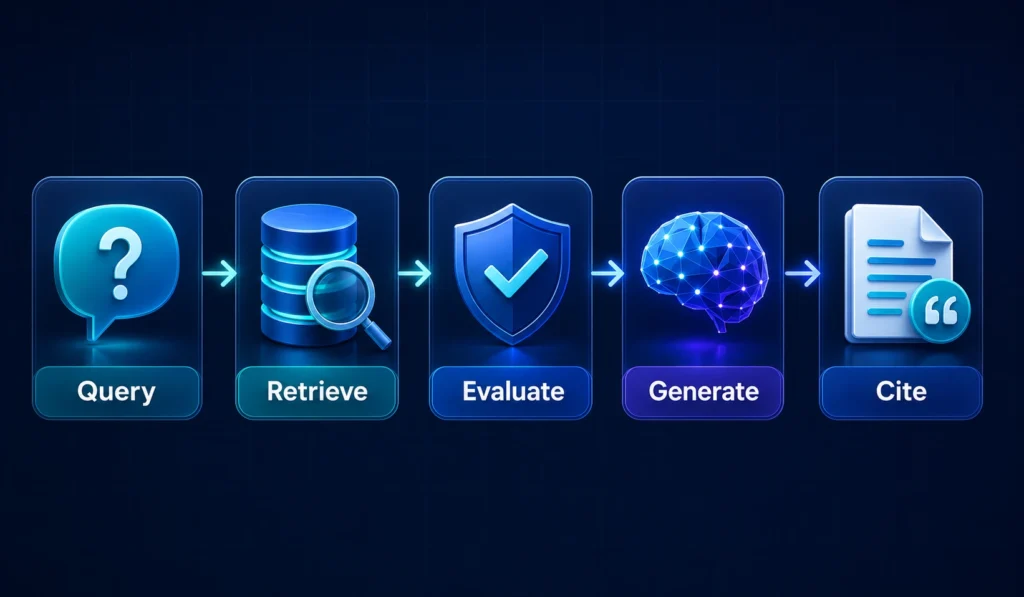
The complete ranking formulas used by AI platforms are proprietary. Nevertheless, publicly available documentation and information-retrieval research reveal a general process involving five important stages.
1. Understanding Search Intent
The first stage involves determining what the person actually wants.
A query such as “best accounting software” could have several meanings. The searcher may want an affordable product, a comparison for small businesses, software available in a particular country or a platform that integrates with existing tools.
AI systems examine the wording, context, location and, where applicable, previous conversation to interpret the intent behind the question.
This is why semantic relevance matters. A page can mention the correct keyword several times and still fail to satisfy the actual purpose of the search.
Strong content addresses the main question while anticipating the information a reader will likely need next.
2. Rewriting and Expanding the Query
A generative search engine may transform one complicated question into several smaller searches.
Google describes this process as “query fan-out.” Its AI features may issue multiple related searches across different subtopics and data sources before creating a response.
For example, a question about the most suitable CRM for a growing company could generate separate searches for:
- Pricing
- User limits
- Integrations
- Customer support
- Security
- Recent customer reviews
ChatGPT Search may also rewrite a question into more focused search queries. This process helps the system collect a broader range of evidence instead of relying on one literal keyword search.
Content that covers related subtopics naturally is therefore more useful than a page created around repeated variations of one phrase.
3. Retrieving Relevant Sources and Passages
The system then retrieves potential webpages, documents or individual passages.
Traditional SEO continues to matter during this stage. A page normally needs to be crawlable, indexable and understandable before it can become a useful candidate.
Important technical elements include:
- Descriptive page titles
- Accessible HTML content
- Clear heading structures
- Relevant internal links
- Canonical URLs
- Mobile usability
- Accurate metadata
- Appropriate crawler access
AI retrieval can also operate at passage level. The system may select a specific paragraph from an article instead of treating the complete page as one answer.
This makes answer-first writing valuable. The opening paragraph under an important heading should provide a complete response before expanding into examples, evidence and explanation.
4. Evaluating and Comparing Sources
Retrieval does not automatically lead to inclusion. The system must still decide which sources can support the answer.
Possible source-selection considerations include:
- Relevance to the exact question
- Completeness of the available information
- Factual consistency with other credible sources
- Freshness when the topic is time-sensitive
- Clarity of the supporting passage
- Original information or first-hand experience
- Reputation and authority of the source
- Consistency of brand names, products and facts
- Ability to verify important claims
Not every AI platform publishes how these signals are weighted. Claims that one specific schema type, content length or backlink metric guarantees inclusion should therefore be treated carefully.
There is no publicly confirmed universal “AI ranking score” that applies equally to ChatGPT, Gemini, Perplexity, Claude and Grok.
5. Generating the Answer and Selecting Citations
After choosing useful information, the language model creates a readable response. It may summarize several sources, compare different viewpoints and attach citations to specific claims.
Citation selection is not always identical to information selection.
A page may influence an answer without receiving a visible citation. Another page may be cited because it provides the clearest evidence for a particular statement. A brand might also be mentioned while a different publication receives the supporting link.
AI visibility should therefore be viewed as a collection of outcomes rather than one ranking position. A brand can be:
- Retrieved as a source
- Used to support the answer
- Mentioned by name
- Cited with a link
- Represented accurately
- Recommended over competitors
Each outcome has a different value and should be measured separately.
What Makes Content More Likely to Be Included?

No individual factor can guarantee inclusion in AI-generated answers. However, several content qualities make a page more useful for both readers and retrieval systems.
Direct Relevance and Topical Depth
Content should answer the primary question completely while addressing its important supporting topics.
An article about how AI search works should not discuss only keywords and schema. It should also explain search intent, query expansion, information retrieval, source evaluation, citations, crawlability and freshness.
This creates topical depth without unnecessary keyword repetition.
Clear and Extractable Answers
Short paragraphs, descriptive headings, comparison tables, definitions and ordered steps make information easier to understand.
Each section should focus on one main idea. Important answers should not be hidden behind a long introduction, excessive promotional language or unrelated background details.
Clear writing helps readers find information quickly while allowing search systems to identify useful passages.
Demonstrable Experience and Expertise
Authority is more persuasive when readers can verify it.
Useful E-E-A-T signals include:
- A named author
- A relevant author biography
- Professional qualifications or experience
- Primary and official sources
- Original examples or research
- Case studies
- Clear publication and update dates
- Transparent research methods
- Accurate business information
- Editorial and correction policies
Google’s people-first content guidance encourages original analysis, substantial value and transparency about who created the content. These principles support traditional SEO and can also make content more suitable for AI search results.
Freshness Where It Matters
Freshness is important for topics involving prices, regulations, software features, research, news or product comparisons.
Evergreen content does not need artificial updates every few weeks. However, it should be reviewed whenever its facts, recommendations or platform descriptions could have changed.
Simply changing the publication date without improving the information does not create genuine freshness.
Technical Access and Structured Data
Search and AI crawlers must be able to access important content.
Pages should not be unintentionally blocked through:
robots.txtnoindexdirectives- Firewall rules
- CDN security settings
- Login requirements
- JavaScript rendering problems
Structured data can give search engines explicit information about an article, author, organization, service or product. However, schema markup does not guarantee a ranking, rich result or AI citation.
Relevant schema types may include:
ArticleorBlogPostingPersonOrganizationBreadcrumbListProductServiceLocalBusiness
All structured data should accurately represent information visible on the page.
What Different AI Search Platforms Reveal
AI search platforms share certain characteristics, but they do not select sources in exactly the same way.
| Platform | Publicly documented behaviour |
|---|---|
| ChatGPT Search | Can rewrite questions, use search partners, retrieve current web information and display cited sources |
| Google AI Overviews and AI Mode | Use Google Search foundations and may run multiple related searches through query fan-out |
| Perplexity | Focuses on web research and source-supported answers, although its complete ranking formula is not public |
| Claude | Can use web search to access current information and provide citations from retrieved sources |
| Grok | Uses real-time web search and current information, including content associated with X |
Results can differ because of:
- Query wording
- Searcher location
- Conversation context
- Available search index
- Time of testing
- Platform configuration
- Whether live search is activated
- Variation in generated responses
A page that appears in one ChatGPT answer may be absent from a similar response later. This does not necessarily mean that the page has been penalized. Another query variation or source set may have been used.
How Brands Can Improve AI Search Visibility
A practical Generative Engine Optimization strategy should strengthen the complete visibility process rather than chase an undocumented algorithm.
Brands can improve their chances of appearing in AI search by:
- Publishing complete answers to genuine customer questions.
- Placing concise answers directly below descriptive headings.
- Adding original data, professional experience and real examples.
- Supporting important claims with credible primary sources.
- Keeping company, service and product information consistent.
- Building internal links between related topic pages.
- Updating time-sensitive information when facts change.
- Using natural primary and secondary keywords.
- Implementing accurate structured data.
- Allowing relevant search and AI crawlers to access important pages.
- Earning authoritative mentions from relevant third-party websites.
- Reviewing how different AI platforms describe the brand.
The foundational Generative Engine Optimization study found that content presentation could improve visibility within its controlled benchmark. However, that result should not be interpreted as a guaranteed method for ranking in every commercial AI platform. More recent research describes AI visibility as a multistage and variable process involving discovery, retrieval, reranking, generation, citation and user behaviour. No single optimization technique can guarantee results.
Common Misconceptions About AI Search Optimization
Schema Is Not a Shortcut to AI Citations
Structured data helps classify information, but schema cannot compensate for weak, inaccurate or unhelpful content.
Longer Content Is Not Automatically Better
Content should be long enough to cover the subject completely. Repetition and filler do not create additional authority.
A shorter article with clear answers and original evidence may outperform a much longer page that provides no additional value.
Keywords Still Matter, but Context Matters More
Keywords help establish the subject of a page. However, modern search systems also examine entities, relationships, supporting concepts and search intent.
The primary keyword should appear naturally in the title, H1, introduction and relevant sections. It should not be forced into every paragraph.
AI Visibility Is Not One Permanent Ranking
AI-generated answers can change between platforms and repeated searches. Visibility should be measured across several questions, locations and dates rather than one isolated prompt.
Becoming a Source AI Systems Can Rely On
Understanding how AI search engines decide what to show ultimately requires understanding what makes information useful. Modern discovery systems still need accessible and relevant webpages, but they also evaluate whether individual passages can support an accurate answer. Clear structure, first-hand knowledge, credible sourcing and consistent facts make that process easier.
The brands most likely to achieve lasting AI search visibility will not be those that repeat keywords most often. They will be those that publish information readers can trust, search engines can understand and generative systems can confidently use as evidence.
Want your brand to appear in traditional search and AI-generated answers? Webix Solutions builds SEO and GEO strategies that improve visibility, credibility and growth.
Frequently Asked Questions
What Role Do Backlinks Play in AI Search Visibility?
Backlinks can support page discovery, domain reputation and traditional organic rankings. However, links alone do not guarantee that a page will be retrieved or cited in an AI-generated answer. The relevance, accuracy and clarity of the supporting passage also influence whether it can be used.
Does Schema Guarantee Inclusion in AI Answers?
No. Structured data can help search systems identify entities and understand page information, but it does not guarantee ranking, citation or inclusion.
Is Longer Content Better for AI Search Visibility?
Not automatically. Content should be long enough to answer the topic completely. Repetitive or padded sections can reduce clarity and user satisfaction.
Why Do AI Citations Change Between Searches?
Citations can change because of query wording, location, updated indexes, conversation context, different retrieved sources and normal variation in generated responses.