
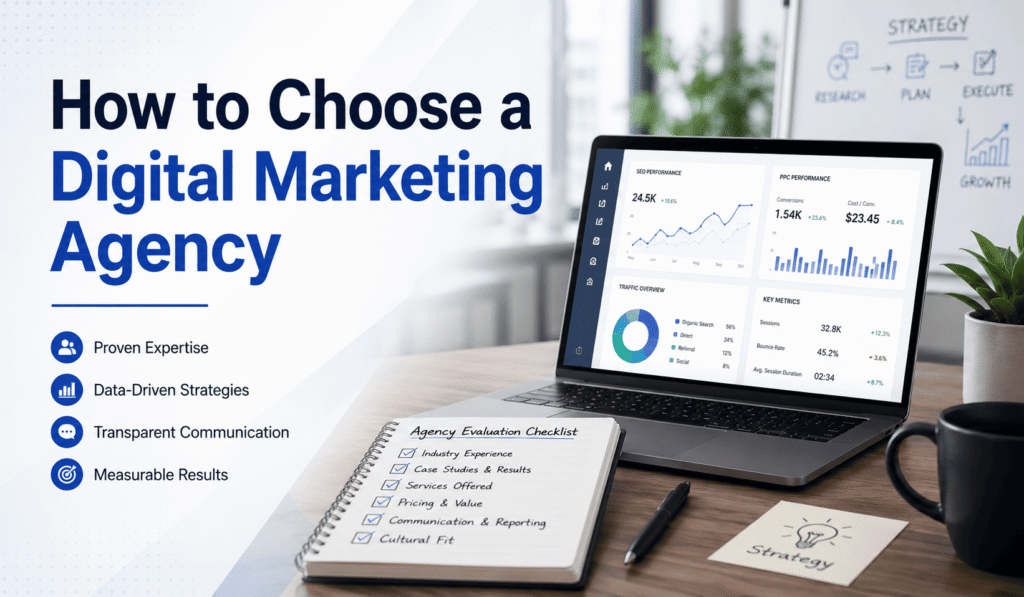
Choosing the right digital marketing agency is an important decision for any business that wants to grow online. A strong agency can help improve search visibility, generate qualified leads, build brand trust, and turn website visitors into customers. The wrong agency, however, can waste budget, create weak campaigns, and leave the business with reports that look impressive but do not show real growth.
That is why a business should not choose a digital marketing agency only because of low pricing, attractive presentations, or big promises. The right agency should understand the business goals, clearly explain its strategy, demonstrate past work, and focus on measurable results. Whether a company needs SEO, paid advertising, website design, social media marketing, content strategy, or full digital growth support, the selection process should be practical and careful.
Quick Answer: How to Choose a Digital Marketing Agency
To choose a digital marketing agency, check its experience, services, case studies, communication, reporting, pricing, and ability to craft custom strategies. The best agency avoids promising instant results. Instead, it studies your business, understands your audience, builds a clear plan, monitors performance, and improves campaigns using data.
Why Choosing the Right Digital Marketing Agency Matters
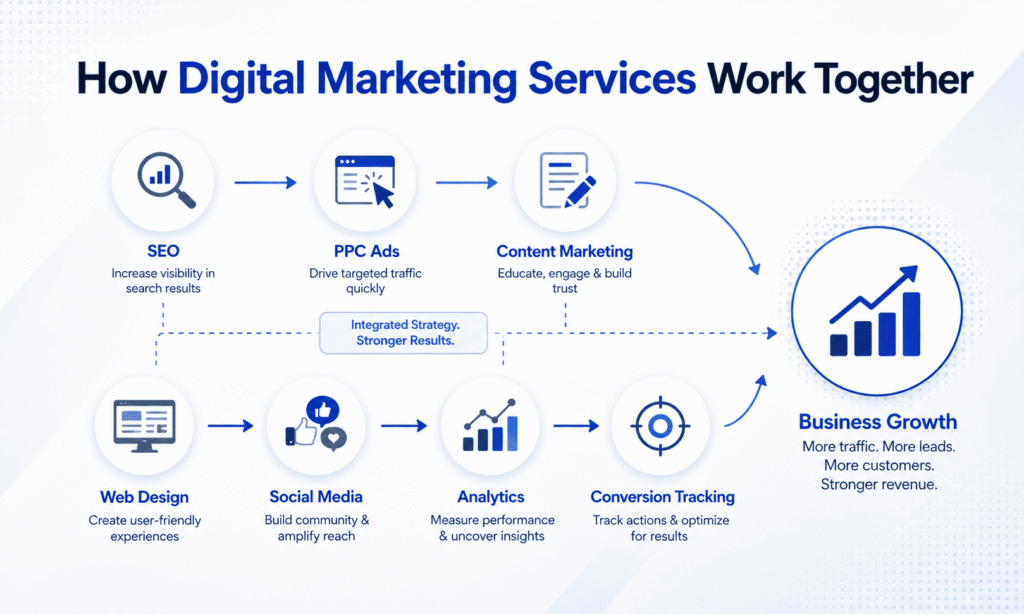
Digital marketing is more than social posts or running ads. Modern online growth requires strategy, search visibility, content, paid campaigns, website experience, analytics, conversion tracking, and brand positioning. A professional digital marketing company helps a business connect all these areas together. SEO can bring long-term organic traffic, paid ads can generate faster leads, content can build trust, and web design can improve conversions. When these services work together, marketing becomes a growth system instead of a random set of activities.
The right agency also helps a business avoid common mistakes, such as targeting the wrong keywords, sending paid traffic to weak landing pages, focusing only on clicks, or publishing content without understanding search intent.
What a Good Digital Marketing Agency Should Understand First
Before recommending SEO, ads, social media, or web design, a good agency reviews your business model, target audience, website, competitors, location, customer journey, and current marketing.
Many businesses do not just have a traffic problem. Issues may include poor tracking, conversions, weak landing pages, or unclear messaging. A site may get visitors but no leads if the call-to-action is weak, the form is hard to find, the page loads slowly, or conversions are not tracked.
That is why choosing a digital marketing agency should not only be about finding someone who can “run ads” or “do SEO.” It should be about finding a team that understands how marketing connects with real business results.
Start by Understanding Business Goals
Before hiring a digital marketing agency, a business should clearly understand what it wants to achieve. Some companies need more website traffic. Others need qualified leads, more phone calls, better local visibility, stronger branding, higher online sales, or improved conversion rates.
Clear goals guide strategy. For example, a local service business may need local SEO, Google Business Profile optimization, lead tracking, and location-based content. An e-commerce store may need product SEO, shopping ads, conversion optimization, and email marketing. B2B may need content, LinkedIn strategy, landing pages, and lead nurturing.
Without clear goals, even a skilled agency may struggle to deliver the right results. A trustworthy agency will ask about your business, customers, competitors, website, and sales process before recommending services.
Check the Agency’s Core Services
A business should choose a digital marketing agency that offers services aligned with its needs. Some agencies specialize in one area, such as SEO or PPC, while others provide complete digital marketing solutions.
Important services to review include:
| Service | Why It Matters |
| SEO | Helps improve organic visibility and long-term website traffic |
| PPC Advertising | Generates faster traffic and leads through paid campaigns |
| Web Design & Development | Improves user experience, trust, and conversions |
| Content Marketing | Builds authority and answers customer questions |
| Social Media Marketing | Supports brand awareness and customer engagement |
| Analytics & Reporting | Tracks what is working and what needs improvement |
| Conversion Optimization | Helps turn visitors into leads, calls, bookings, or customers |
The best agency will not recommend every service at once. It identifies what matters most based on your position, budget, competition, and goals.
Look for Case Studies and Real Proof
Case studies are one of the strongest indicators of a reliable digital marketing agency. A case study shows how the agency handled a real business problem, the strategy it used, and the results achieved.
A business should look for case studies that explain the client’s challenge, the services provided, the strategy used, the results achieved, and the campaign timeline. Strong examples may include improvements in organic traffic, keyword rankings, leads, conversions, cost per lead, ad performance, or sales growth.
Claims like “helped many businesses grow” are not enough. A good agency explains what worked and why. If it cannot share examples, testimonials, or campaign proof, consider it a warning. Review Their Reporting and Communication Process
Transparent reporting is one of the biggest differences between a professional agency and a weak one. A business should know what work is being done, why it matters, and how performance is changing.
A good agency provides reports that clearly explain important metrics. These may include organic traffic, keyword rankings, conversions, cost per lead, ad spend, click-through rate, engagement, website behavior, and return on investment.
However, reports should not be filled with numbers only. The agency should also explain what the data means, what has improved, what needs work, and what actions will be taken next.
Strong communication includes regular updates, clear timelines, honest feedback, and fast responses. A business should feel that the agency is a growth partner, not just a vendor sending monthly reports.
Understand Pricing and Budget Transparency
Pricing is another important factor when hiring a digital marketing agency. The cheapest option is not always the best, and the most expensive agency is not always the right fit.
A reliable agency should explain what is included in its pricing. The business should know whether the cost covers strategy, content creation, technical SEO, ad management, design, reporting, meetings, or campaign setup.
Vague pricing causes confusion. Hidden fees, unclear deliverables, and constant upselling are red flags. A professional agency respects your budget and offers a realistic plan.
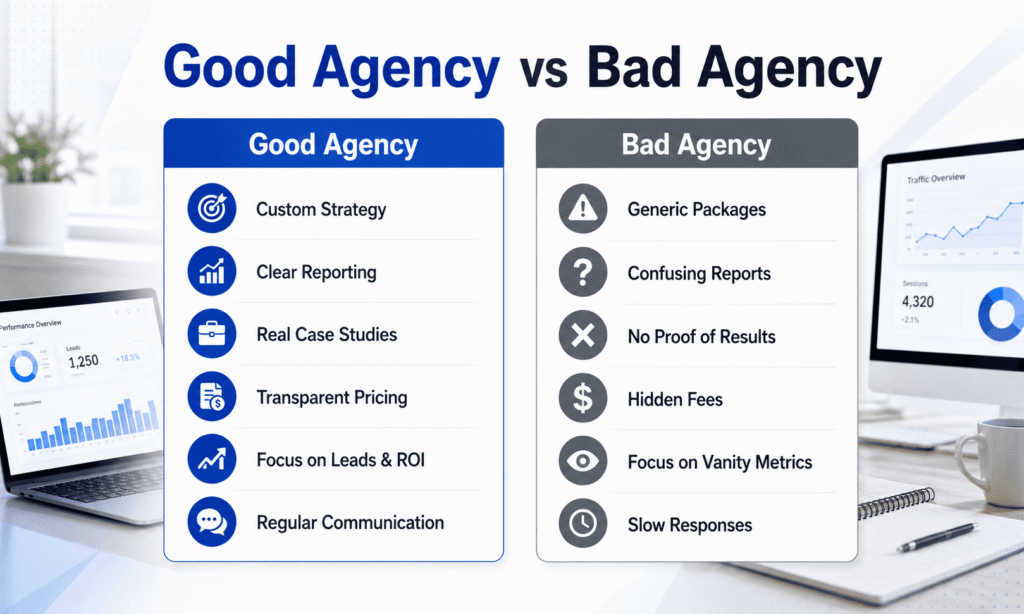
Good Agency vs Bad Agency Comparison:
| Good Digital Marketing Agency | Bad Digital Marketing Agency |
| Creates a custom strategy | Offers the same package to every client |
| Shows case studies and proof | Makes claims without evidence |
| Gives transparent reports | Sends confusing or limited reports |
| Sets realistic expectations | Promises instant rankings or guaranteed sales |
| Explains pricing clearly | Hides fees or changes costs later |
| Focuses on leads and ROI | Focuses only on likes, clicks, or impressions |
| Communicates regularly | Responds slowly or avoids questions |
Red Flags to Watch Before Hiring an Agency
A business should be careful if an agency makes promises that sound too good to be true. No honest agency can guarantee a number-one ranking on Google, instant leads, or fixed revenue growth within a few days. Digital marketing depends on competition, budget, website quality, customer demand, search algorithms, and campaign testing.
Other red flags include poor communication, no clear process, lack of transparency, no reporting structure, weak portfolio, generic strategy, or pressure to sign a contract quickly.
An agency that avoids questions about tracking, strategy, deliverables, timelines, or results may not be the right partner.
Common Mistakes Businesses Make When Choosing a Digital Marketing Agency
Many businesses choose a digital marketing agency too quickly. Some select the cheapest package, some choose the agency with the most attractive presentation, and others trust agencies that promise fast results without asking deeper questions.
One common mistake is focusing only on traffic. More traffic does not always mean more customers. If the website has weak content, poor calls to action, slow loading speed, or no conversion tracking, even good traffic may not produce leads.
Another mistake is ignoring reporting. A business should know what work is being done, what results are improving, and what the next steps are. If an agency cannot explain its monthly report in simple language, it may not be the right partner.
A third mistake is hiring an agency without checking whether it understands the business’s industry, location, and customer journey. Digital marketing should never be one-size-fits-all.
Questions to Ask Before Choosing a Digital Marketing Agency
Before making a final decision, a business should ask practical questions such as:
- What strategy would be recommended for this business?
- Which services are most important at the beginning?
- How will success be measured?
- What tools will be used for tracking and reporting?
- How often will reports and updates be provided?
- Can the agency show relevant case studies or examples?
- Who will manage the account?
- How long does it usually take to see meaningful results?
- What happens if campaigns do not perform as expected?
The answers reveal if the agency truly understands strategy or only wants to sell services. Final Decision Checklist Before Hiring a Digital Marketing Agency
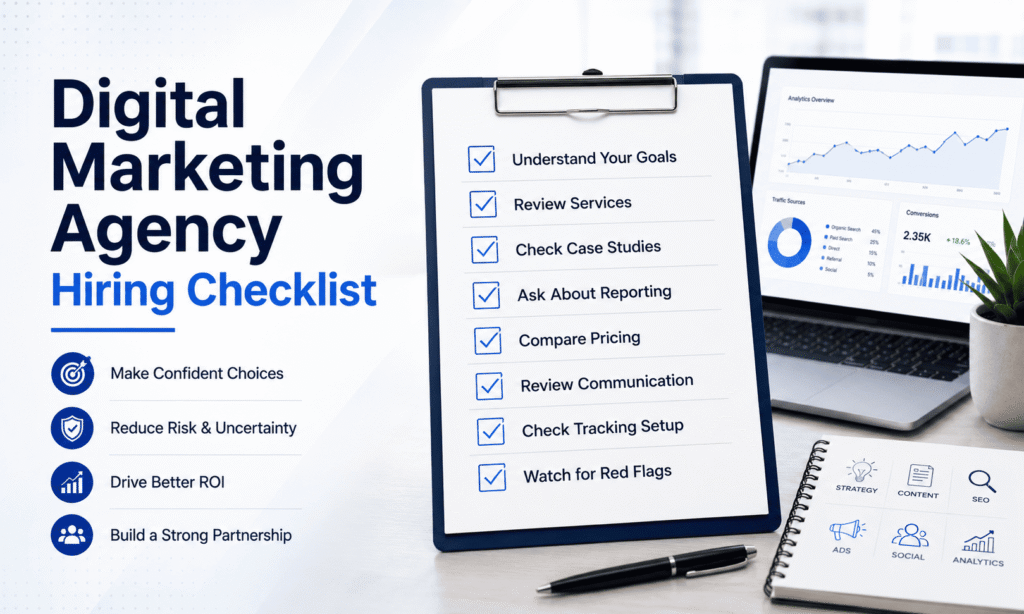
Before choosing a digital marketing agency, a business should review more than pricing or service packages. The right agency should understand the business goals, explain its process clearly, and show how its work will support real growth. This checklist can help business owners compare agencies with more confidence.
| What to Check | Why It Matters | Good Sign | Warning Sign |
| Business Understanding | The agency should understand the company, audience, goals, and market before suggesting services. | They ask about goals, customers, competitors, and current challenges. | They recommend a package before learning about the business. |
| Strategy | A clear strategy shows how SEO, ads, content, design, and tracking will work together. | They explain the plan step by step. | They only talk about general services without a clear direction. |
| Case Studies | Case studies prove that the agency has handled real campaigns before. | They show examples, results, and the process behind the work. | They make claims but cannot show proof. |
| Reporting | Reports help the business understand what is working and what needs improvement. | They provide clear reports with actions and explanations. | They send confusing reports filled with vanity metrics. |
| Pricing | Transparent pricing helps avoid hidden costs and budget issues. | They explain what is included in the monthly cost. | Their pricing is vague or changes after the first call. |
| Communication | Good communication keeps the campaign organized and builds trust. | They respond clearly and provide regular updates. | They are slow, unclear, or hard to reach. |
| Customization | Every business needs a strategy based on its goals, industry, and budget. | They create a custom plan. | They offer the same package to every client. |
| Tracking | Proper tracking shows whether marketing is producing leads, calls, sales, or bookings. | They discuss conversion tracking, forms, calls, and ROI. | They only focus on clicks, impressions, or traffic. |
| Expectations | Honest expectations protect the business from unrealistic promises. | They explain realistic timelines and growth stages. | They guarantee instant rankings, leads, or revenue. |
| Long-Term Support | Digital marketing needs testing, updates, and improvement over time. | They focus on long-term growth and campaign optimization. | They only promise quick wins without a clear follow-up plan. |
A business should choose the agency that gives clear answers, shows real proof, and focuses on measurable business results. If an agency cannot explain its strategy, pricing, reporting, or expected timeline, it may not be the right partner.
Why Industry Understanding Matters
A digital marketing agency does not always need to work in only one industry, but it should understand its target market. Marketing for a dental clinic is different from marketing for a real estate company, cleaning service, e-commerce store, construction company, or software business.
Industry understanding helps with keyword selection, content tone, ad targeting, landing page structure, customer pain points, and conversion strategy. An experienced agency will study the business, competitors, and audience before creating a plan.
Choose an Agency That Focuses on Real Business Results
A common mistake is choosing an agency that talks only about traffic, followers, impressions, or clicks. These metrics can be useful, but they do not always show business growth. A stronger agency focuses on meaningful results such as qualified leads, phone calls, form submissions, booked appointments, sales, conversion rate, cost per acquisition, and return on investment.
Marketing should support the business’s bottom line. That is why tracking must be set up properly from the beginning. Without proper tracking, it becomes difficult to know which campaigns are actually working.
Choose a Digital Marketing Partner That Builds Long-Term Growth
The right digital marketing agency should act like a long-term growth partner. It should understand the business, study the market, create a clear strategy, measure performance, and improve campaigns over time. A good agency does not rely on shortcuts. It builds visibility, trust, and conversions through consistent work and smart decision-making.
For businesses that want SEO, web design, paid advertising, content marketing, social media management, and online growth support, Webix Solutions helps create digital marketing strategies focused on visibility, leads, and real business growth.
FAQ’s
How do I choose a digital marketing agency?
To choose a digital marketing agency, a business should review the agency’s experience, services, case studies, pricing, communication, reporting process, and ability to create a custom strategy. The right agency should understand the business goals before recommending SEO, paid ads, social media, web design, or content marketing.
What are the red flags when hiring a digital marketing agency?
Common red flags include guaranteed first-page rankings, unclear pricing, no case studies, and reports that only focus on clicks or impressions. A business should also be cautious if an agency promises instant results without reviewing the business.
What questions should I ask before hiring a digital marketing agency?
Before hiring a digital marketing agency, ask about its strategy, past results, reporting process, pricing, team experience, communication schedule, contract terms, and how success will be measured.
Is it better to hire a full-service digital marketing agency?
A full-service digital marketing agency can be a strong choice when a business needs SEO, PPC advertising, web design, content marketing, social media, and analytics to work together. This is useful because digital growth often depends on multiple channels.
How much does a digital marketing agency cost?
The cost of a digital marketing agency depends on the services, campaign size, competition, location, and business goals. SEO, paid ads, content marketing, social media, and web design may all have different pricing models.
Should a business choose a local or remote digital marketing agency?
A business can choose either a local or remote digital marketing agency if the agency understands its market, audience, and goals. A local agency may be helpful for location-based businesses, while a remote agency can still deliver strong results if it has a clear process, strong communication, and proven digital marketing experience.
How do I know if a digital marketing agency is delivering results?
A business can know if an agency is delivering results by reviewing leads, calls, form submissions, sales, conversions, keyword growth, traffic quality, cost per lead, and return on investment. Good reporting should explain not only what changed, but also what actions the agency will take next.
What should a digital marketing agency include in its monthly report?
A monthly report should include campaign performance, completed work, traffic data, keyword updates, ad results, conversions, lead quality, recommendations, and next steps. The report should be easy to understand and connected to the business’s main goals.
Written by: Webix Solutions Team
Last Updated: 8 May, 2026