
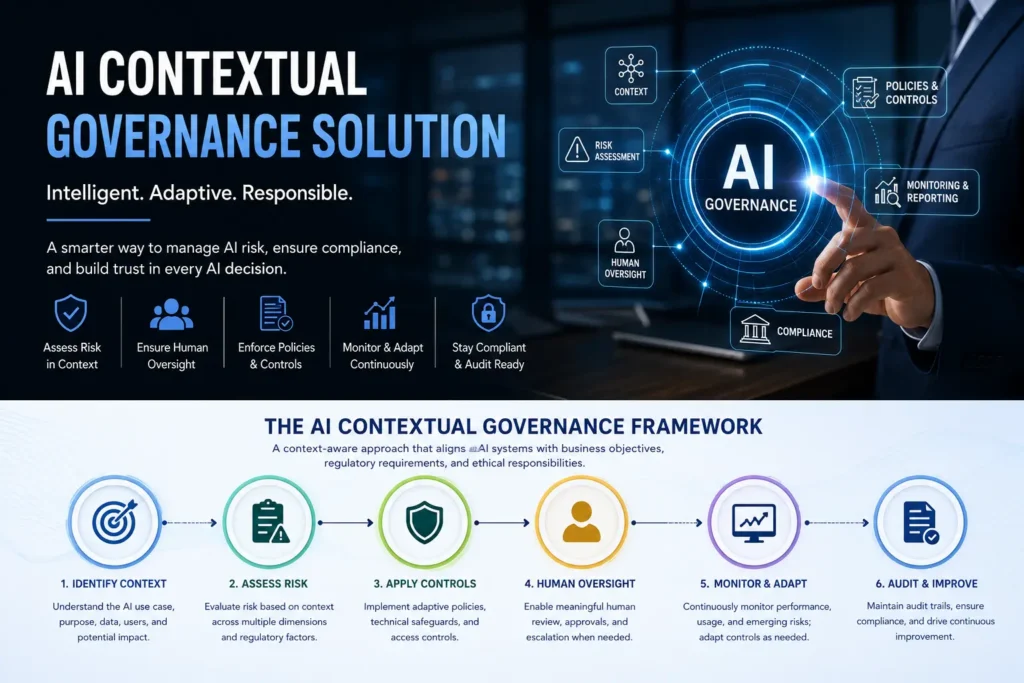
Artificial intelligence is moving beyond isolated experiments and becoming part of everyday business operations. AI systems now support customer service, recruitment, fraud detection, financial analysis, healthcare administration, marketing, cybersecurity, and internal decision-making. As these systems become more influential, organizations need more than static policies and occasional compliance reviews. They need an AI contextual governance solution that adjusts oversight according to how, where, and why an AI system is being used.
Contextual governance recognizes that an AI model cannot be judged by its technical design alone. The same model may present minimal risk when summarizing internal meeting notes but create significant legal, ethical, and operational risks when evaluating job applicants or supporting credit decisions.
An effective governance framework must therefore consider the complete context surrounding each AI use case, including its purpose, users, data, authority, consequences, location, and regulatory environment.
What Is an AI Contextual Governance Solution?
An AI contextual governance solution is a framework or platform that applies governance controls according to the specific context of an AI use case.
Instead of applying identical rules to every AI system, it evaluates factors such as:
- The purpose of the AI system
- The sensitivity of the data involved
- The people affected by its decisions
- The level of automation or autonomy
- The consequences of incorrect outputs
- The industry and jurisdiction in which it operates
- The need for human review
- The system’s current performance and risk level
Based on these factors, the solution can assign a risk category, determine approval requirements, enforce technical safeguards, trigger human oversight, and create an audit trail.
This approach complements established governance frameworks. The NIST AI Risk Management Framework, for example, organizes AI risk management around four functions: Govern, Map, Measure, and Manage. NIST presents the framework as a flexible, voluntary resource for incorporating trustworthiness into the design, development, deployment, and evaluation of AI systems.
Why Traditional AI Governance Is No Longer Enough
Traditional technology governance was primarily designed for predictable software systems. Conventional software generally follows predefined instructions, produces repeatable results, and changes when developers intentionally update it.
AI systems operate differently. Their outputs may vary according to the input, training data, model version, retrieved information, user behavior, and surrounding conditions. Generative AI applications and autonomous agents may also produce unexpected responses or take actions that were not individually programmed.
A static governance checklist may confirm that a model passed an assessment before deployment. However, that assessment may not reveal whether:
- The model is being used for a new purpose
- Sensitive information has entered its workflow
- Performance has declined
- Users are relying on outputs without sufficient review
- A vendor has changed the underlying model
- The system has gained additional permissions
- A new regulation applies to its use
Contextual AI governance treats governance as a continuous operational process rather than a one-time approval exercise.
The need for risk-based governance is also reflected in the European Union’s AI Act, which separates AI uses into different risk levels rather than imposing identical requirements on every system. Its official framework distinguishes unacceptable, high, limited, and minimal or no-risk applications.
Context Determines the Real Risk of an AI System
The model itself is only one part of an AI system’s risk profile. Its business application often determines the level of oversight required.
For example, an AI writing assistant used to suggest social media captions may have limited consequences when it produces an inaccurate sentence. A similar language model used to summarize medical records, assess insurance claims, screen job applicants, or prepare legal recommendations could affect a person’s health, finances, employment, or legal rights.
A contextual assessment examines several dimensions.
Business Purpose
The organization must establish what the AI system is intended to accomplish. A clearly defined purpose helps prevent function creep, in which a system gradually becomes used for tasks that were never assessed or approved.
Data Context
Governance requirements change according to whether the system processes public information, internal business records, intellectual property, financial data, personally identifiable information, or health information.
Human Impact
An application that supports low-impact administrative work requires different controls from one that influences employment, education, healthcare, lending, insurance, public services, or access to essential resources.
Level of Autonomy
AI may provide recommendations, generate drafts, make decisions, or take direct action. Greater authority generally requires stronger access controls, monitoring, approval limits, and escalation procedures.
Regulatory Environment
Different industries and regions impose different responsibilities. A contextual governance platform must connect each use case with the regulations, standards, contractual obligations, and internal policies relevant to that situation.
Core Components of an AI Contextual Governance Solution
A reliable solution should connect governance policies with operational systems. It must do more than store documents or record model names.
1. Centralized AI Use-Case Inventory
The organization first needs visibility into its AI ecosystem. The inventory should include internally developed models, third-party AI tools, embedded AI features, generative AI applications, automated decision systems, and AI agents.
Each entry should record:
- Business owner
- Technical owner
- Intended purpose
- Model and vendor
- Data sources
- Affected users
- Deployment location
- Connected systems
- Decision authority
- Current lifecycle stage
- Applicable policies and regulations
The use case, rather than the model alone, should become the primary unit of governance. One model may support several applications, each with a different risk profile.
2. Context-Aware Risk Classification
The governance solution should calculate risk according to the system’s actual use. A classification engine can evaluate potential harm, data sensitivity, scale, autonomy, explainability requirements, legal exposure, and human involvement.
Low-risk applications may receive automated approval after basic security and privacy checks. Medium-risk systems may require technical testing and business-owner approval. High-impact systems may require legal review, an AI impact assessment, independent validation, senior management approval, and continuous monitoring.
This structure prevents low-risk innovation from becoming trapped in unnecessary bureaucracy while directing governance resources toward the most consequential systems.
3. Adaptive Policies and Technical Controls
Policies must be converted into enforceable controls.
Depending on the context, a solution may apply:
- Role-based access controls
- Data masking or redaction
- Approved-model restrictions
- Prompt and output filtering
- Human approval requirements
- Transaction or spending limits
- Restricted tool permissions
- Confidence thresholds
- Automated escalation
- Emergency shutdown procedures
When an AI system’s context changes, its control level should also change. An internal assistant that gains access to customer records, financial systems, or external communication tools should automatically trigger reassessment.
4. Continuous Monitoring
AI governance cannot end at deployment. The organization must monitor whether the system continues to perform within approved boundaries.
Monitoring may cover:
- Accuracy and error rates
- Hallucination frequency
- Model and data drift
- Bias or unfair outcomes
- Security events
- Unusual usage patterns
- Policy violations
- Failed human reviews
- Changes to model versions
- Unauthorized integrations
The OECD AI Principles emphasize that AI systems should remain robust, secure, and safe throughout their lifecycle. They also recommend ongoing risk management, traceability, transparency, and accountability according to the role and context of each AI actor.
5. Human Oversight and Escalation
Human oversight should be designed around the potential impact of the AI system.
In some cases, a person must review every output before action is taken. In others, the system may operate independently within defined limits while a human monitors exceptions. High-risk decisions should include clear routes for intervention, appeal, correction, and system suspension.
Human involvement must be meaningful. A reviewer who lacks time, information, training, or authority cannot provide effective oversight.
6. Documentation and Audit Trails
A contextual governance solution should preserve evidence of how decisions were made.
The audit record may include:
- The model version used
- The information supplied to the model
- The output generated
- The policy active at that time
- The person or system that approved the action
- Monitoring results
- Identified risks
- Applied safeguards
- Changes made after deployment
Traceability allows an organization to investigate incidents, respond to regulators, demonstrate due diligence, and understand which information influenced an AI-assisted decision.
Alignment With AI Governance Standards
An organization does not need to create its governance framework without external guidance. A contextual approach can operationalize several recognized standards.
ISO/IEC 42001 provides a management-system structure for organizations developing, providing, or using AI systems. ISO also lists ISO/IEC 23894 for AI risk management and ISO/IEC 42005 for AI system impact assessments.
The NIST AI RMF offers flexible practices for governing, mapping, measuring, and managing AI risk. Its framework is intended to support organizations across different sizes, sectors, and use cases.
The OECD AI Principles add human-centered values, fairness, transparency, explainability, robustness, security, safety, and accountability. The principles were updated in May 2024 to reflect changes in AI technology and policy.
Together, these resources can provide the policy foundation while contextual governance turns their principles into practical workflows and controls.
How Organizations Can Implement Contextual AI Governance
Implementation should begin with governance foundations rather than purchasing software immediately.
Establish Ownership
Senior leadership should define risk tolerance and accountability. Legal, compliance, security, data, product, procurement, and business teams should have documented responsibilities.
Discover Existing AI Use Cases
The organization should identify both approved and unapproved AI usage. This includes employee use of public generative AI tools, AI features included in software subscriptions, vendor-operated models, and experimental systems.
Define Risk Tiers
Risk levels should be based on impact, autonomy, data sensitivity, scale, and regulatory exposure. Each tier should have clear approval, testing, monitoring, and documentation requirements.
Integrate Governance Into Workflows
Governance should be connected to procurement, software development, data access, security review, model deployment, vendor management, and incident response. Teams should not have to manage governance through disconnected spreadsheets and email chains.
Measure Governance Performance
Leadership should track measurable indicators such as:
- Percentage of AI systems registered
- Number of unapproved tools discovered
- Time required to assess a use case
- Percentage of high-risk systems continuously monitored
- Number of unresolved governance exceptions
- Frequency of model reassessments
- Number and severity of AI-related incidents
- Time required to investigate an incident
These metrics reveal whether governance is actively reducing risk or merely creating documentation.
Benefits of an AI Contextual Governance Solution
A mature contextual framework offers several business advantages.
It accelerates responsible innovation by creating a faster approval route for low-risk applications. It improves regulatory readiness by connecting each system to applicable requirements. It strengthens accountability by assigning clear ownership. It also increases trust by making AI decisions more traceable, explainable, and reviewable.
Most importantly, contextual governance allows controls to evolve alongside the organization. AI systems, business objectives, data sources, regulations, and user expectations will continue to change. Governance must be capable of responding to those changes without rebuilding the entire program.
Common Implementation Mistakes
Organizations often weaken their governance programs by:
- Governing models without documenting individual use cases
- Treating all AI systems as equally risky
- Relying entirely on manual questionnaires
- Failing to reassess third-party AI tools
- Monitoring technical accuracy but ignoring human impact
- Assigning responsibility without decision-making authority
- Collecting documentation without enforcing controls
- Allowing high-impact AI outputs to bypass meaningful human review
Another common mistake is treating regulatory compliance as the complete purpose of governance. Compliance is essential, but a strong program must also address operational reliability, customer trust, cybersecurity, business continuity, fairness, and strategic risk.
The Future of Contextual AI Governance
AI governance is gradually moving from policy documents toward integrated control systems. Future governance platforms are likely to evaluate context continuously, detect changes automatically, adjust safeguards, and generate compliance evidence as part of normal operations.
The growth of agentic AI will make this capability even more important. AI agents may access applications, retrieve company information, communicate externally, delegate tasks, and initiate transactions. Their permissions and authority must therefore be limited according to user identity, purpose, data sensitivity, time, location, and potential impact.
Organizations that establish contextual governance early will be better positioned to expand AI without sacrificing accountability. Those that depend only on static policies may struggle to understand where AI is operating, what authority it possesses, and how much risk it creates.
Final Verdict
An AI contextual governance solution gives organizations a practical way to govern AI according to real-world impact rather than technical labels alone.
It combines AI inventory management, contextual risk classification, adaptive controls, continuous monitoring, human oversight, and audit-ready documentation. By aligning these capabilities with frameworks such as NIST AI RMF, ISO/IEC 42001, the OECD AI Principles, and risk-based regulation, organizations can create governance that supports both innovation and responsibility.
The strongest governance program is not necessarily the one with the largest number of policies. It is the one that applies the right safeguard, to the right AI system, at the right moment, for the right reason.
Frequently Asked Questions
What is contextual governance in AI?
Contextual governance is an approach that determines AI controls according to the system’s purpose, data, users, autonomy, potential impact, and regulatory environment.
How is contextual AI governance different from traditional governance?
Traditional governance often applies static rules and scheduled assessments. Contextual governance continuously adjusts oversight according to changes in risk, system behavior, data, permissions, and business use.
What should an AI governance solution include?
It should include an AI inventory, risk assessments, policy management, approval workflows, monitoring, human-oversight controls, incident management, regulatory mapping, and audit trails.
Does every AI system require the same level of governance?
No. Low-impact internal tools generally need fewer controls than systems that influence employment, healthcare, credit, insurance, safety, or access to essential services.
Can contextual governance support regulatory compliance?
Yes. It can map individual AI use cases to relevant laws, standards, risk classifications, controls, documentation, monitoring requirements, and reporting obligations.
When should an organization implement AI contextual governance?
Implementation should begin when AI moves beyond isolated experimentation and starts processing business data, interacting with customers, supporting decisions, or taking actions within operational systems.