

Architecture is still one of the most referral-driven professions, but referrals alone no longer create a stable project pipeline. Homeowners, developers, commercial clients, and institutional buyers now research architecture firms online before ever contacting them. They compare websites, scan portfolios, check reviews, study social media activity, and look for proof that a firm understands their type of project. That is why online marketing for architects has become more than posting beautiful project photos. It is a complete visibility system. A strong architecture marketing strategy connects search visibility, project storytelling, social proof, platform selection, email nurturing, and conversion-focused website design.
This guide explains what actually works in 2026 for architecture firms that want better inquiries, stronger positioning, and a more predictable pipeline.
Why Digital Marketing Matters for Architecture Firms
Traditional referrals still matter, but they are no longer enough on their own. A referral may introduce a potential client to your firm, but your digital presence usually decides whether that person trusts you enough to book a consultation.
Before contacting an architect, most clients want to know:
- Does this firm design the type of project I need?
- Have they worked in my city or region?
- Do they understand my budget level and project goals?
- Is their work credible and well-documented?
- Can I trust them with a major financial decision?
Your website, search presence, project pages, reviews, social media, and case studies answer these questions before you ever speak to the client.
This is where digital marketing for architecture firms becomes powerful. It turns your online presence into a trust-building system that supports referrals, attracts new prospects, and helps serious buyers choose your firm with confidence.
Build a Website That Works Like a Portfolio and a Sales Tool
An architecture website should do more than display attractive images. It should explain what the firm does, who it serves, where it works, why its process is valuable, and how a visitor can take the next step.
A high-performing architecture website needs five core elements:
- Clear positioning above the fold
- Strong project photography with optimized image loading
- Service pages for specific project types
- Case studies that explain process and outcomes
- Clear calls to action on every important page
Many architecture websites are visually impressive but commercially weak. They look beautiful, but they do not clearly explain services, guide visitors to consultation, or improve search visibility.
For better results, your website should answer these questions quickly:
- What type of architecture do you specialize in?
- What locations do you serve?
- What types of clients do you work with?
- What makes your design process different?
- What should a visitor do next?
Technical performance also matters. Large renderings and project photos should be compressed, converted to WebP or AVIF, lazy-loaded, and served from a reliable hosting provider or CDN. A slow website can reduce conversions and weaken SEO performance, especially on mobile devices.
SEO for Architects: Build Search Visibility Around Real Client Intent
SEO for architects is not just about ranking for broad keywords like “architecture firm.” The strongest SEO strategy focuses on the way real clients search.
A homeowner may search:
- Residential architect near me
- Custom home architect in Austin
- Modern home architect in Toronto
- Passive house designer near me
A commercial client may search:
- Commercial architecture firm
- Hospitality design architect
- Healthcare architecture firm
- Office building architect
That is why architecture SEO should be built around three main layers.
1. Local SEO
Most architecture firms serve specific cities, regions, or markets. Local SEO helps your firm appear when clients search for architects in your service area.
Important local SEO actions include:
- Optimize your Google Business Profile
- Add accurate service areas
- Collect client reviews
- Publish city-focused service pages
- Add location signals to project pages
- Use local keywords naturally in page titles and headings
- Add LocalBusiness or ProfessionalService schema
A strong Google Business Profile can be especially valuable for residential architects, interior architects, renovation specialists, and boutique firms competing in local markets.
2. Service-Specific SEO
Generic pages are harder to rank and harder to convert. Instead of a single general services page, architecture firms should create dedicated pages for high-value services.
Examples include:
- Custom home architecture
- Residential architecture
- Commercial architecture
- Interior architecture
- Sustainable architecture
- Adaptive reuse
- Hospitality design
- Healthcare architecture
- Multi-family residential design
- Renovation and extension design
These pages help Google understand your expertise and help visitors quickly see whether your firm matches their needs.
3. Authority SEO
Search engines and AI systems trust firms that are mentioned by credible sources. For architects, authority can come from:
- Architecture publications
- Award programs
- Local business directories
- Industry associations
- University or speaking profiles
- Press features
- Project citations
- Client testimonials
Publications such as ArchDaily, Dezeen, Architizer, design magazines, local business journals, and regional architecture platforms can support both brand credibility and SEO authority.
Digital Marketing Channels for Architects: Which Platforms Actually Work?
Not every digital channel works the same way for architecture firms. Some platforms bring direct project inquiries. Others build a reputation over time. The best platform depends on your firm type, audience, and project value.
The mistake many firms make is trying to post everywhere without a clear strategy. A residential architecture firm does not need the same platform mix as a commercial architecture practice. An interiors-focused studio may benefit more from Pinterest and Instagram, while a firm targeting developers may see stronger results from LinkedIn, case studies, and PR.
The table below shows how each major platform fits into an architecture marketing strategy.
Digital Marketing Platform Comparison for Architecture Firms
| Platform | Best For | Lead Quality | Time Investment | Best Content Type | Time to Results |
| Google Search | Local discovery, service-based searches, high-intent leads | High | Medium to high | Service pages, case studies, local pages, FAQs | 3-6 months |
| Google Business Profile | Local architecture firms, residential architects, renovation firms | High | Low to medium | Reviews, project photos, service updates, local posts | 1-3 months |
| Houzz | Residential architecture, interiors, custom homes, renovations | High | Medium | Project photos, ideabooks, reviews, completed projects | 1-3 months |
| Visual reputation, brand awareness, design inspiration | Low to medium | High | Project photos, reels, process posts, behind-the-scenes content | 6-12 months | |
| Residential design, interiors, early-stage research | Medium | Low to medium | Mood boards, detail shots, project images, design ideas | 3-6 months | |
| Commercial, institutional, developer, and B2B clients | High | Medium | Founder posts, project updates, thought leadership, case studies | 3-6 months | |
| YouTube | Project walkthroughs, education, trust building | Medium to high | High | Walkthroughs, design explainers, client education videos | 6-12 months |
| Email Marketing | Long sales cycles, referrals, past clients, warm prospects | High for warm audiences | Low to medium | Newsletters, project updates, insights, resources | 3-6 months |
The practical takeaway is simple. Residential architecture firms should prioritize Google Business Profile, Houzz, SEO, Instagram, and Pinterest. Commercial architecture firms should prioritize SEO, LinkedIn, case studies, email, and PR. Both should use their website as the central conversion point.
Best Marketing Channels by Architecture Firm Type
Different firms need different marketing priorities. This section helps architecture firms choose the right starting point, avoiding wasted time across every platform.
| Firm Type | Best Channels | Why It Works |
| Residential architects | Google Business Profile, Houzz, SEO, Instagram, Pinterest | Clients search locally and rely heavily on visuals, reviews, and project examples |
| Commercial architects | LinkedIn, SEO, case studies, PR, email | Decision-makers need credibility, proof, and long-term trust |
| Interior architecture firms | Instagram, Pinterest, Houzz, SEO | Visual discovery and inspiration-based research are important |
| Sustainable architecture firms | SEO, long-form content, YouTube, PR, awards | Educational content builds authority around technical expertise |
| Boutique design studios | Instagram, website, PR, email, case studies | Brand identity and storytelling help justify premium positioning |
| Large architecture firms | PR, LinkedIn, publications, awards, SEO | Authority and visibility support major institutional and developer projects |
This simple channel focus gives architecture firms a clearer path. Instead of asking, “Should we post more?” the better question is, “Which platform supports the type of client we actually want?”
Content Marketing for Architects: Build Trust Before the First Call
Content marketing for architects should not be random blogging. It should help potential clients understand your expertise, process, design thinking, and project outcomes.
The strongest content formats for architecture firms are case studies, project stories, educational guides, and short videos.
1. Case Studies
Case studies are one of the most powerful marketing assets an architecture firm can publish. A strong case study should include:
- Client brief
- Site conditions
- Design challenge
- Planning or zoning constraints
- Design approach
- Material choices
- Sustainability decisions
- Final result
- Project photos
- Client outcome
This type of content proves expertise better than a short portfolio gallery. It also creates strong long-tail SEO opportunities because it naturally includes project type, location, design style, and service details.
2. Educational Guides
Educational content works well because many clients research for months before contacting an architect.
Useful topics include:
- How much does a custom home architect cost?
- What happens during schematic design?
- How long does an architecture project take?
- Renovation vs rebuild: which option is better?
- What should you prepare before hiring an architect?
- How to choose the right architecture firm
These topics capture clients early in their decision-making journey and position your firm as a helpful expert.
3. Founder-Led Video
Short videos can build trust faster than written content alone. Architects can use video to explain design decisions, show project walkthroughs, discuss common client questions, or share lessons from completed work.
Video does not need to feel overly polished. In many cases, clear and authentic founder-led content performs better because it feels more human and trustworthy.
4. Project Process Content
Many clients do not understand how architects work. Content that explains your process can reduce hesitation and improve the quality of inquiries.
Useful process topics include:
- What happens in the first consultation?
- What is included in concept design?
- How are drawings developed?
- How do architects coordinate with engineers and contractors?
- What should clients expect during approvals?
This type of content helps clients feel prepared before they contact your firm.
Email Marketing for Architects: Stay Visible During Long Sales Cycles
Architecture has a long sales cycle. A homeowner may follow a firm for a year before starting a custom home. A developer may track a commercial architect’s work for months before reaching out. Email marketing helps your firm stay visible during that decision window.
A simple monthly email can include:
- Recent project updates
- Design insights
- Planning tips
- Local market commentary
- Award or press updates
- Educational resources
- Behind-the-scenes process notes
The goal is not to sell aggressively. The goal is to stay trusted, remembered, and relevant until the prospect is ready to move forward.
Email also supports referrals. Past clients, consultants, contractors, and industry partners are more likely to recommend your firm if they continue seeing your work and expertise.
PR, Awards, and Publications: Build Authority Beyond Your Website
Architecture is a credibility-driven industry. Being featured in respected publications or shortlisted for awards can improve trust, brand perception, SEO authority, and referral confidence.
Architecture firms should regularly submit completed projects to:
- Architecture publications
- Local design magazines
- Regional business journals
- AIA or industry award programs
- Sustainability award programs
- Interior design platforms
- Community development publications
These placements create authority signals that continue working over time. They can also support your social media, email newsletter, website credibility, and backlink profile.
For many firms, PR and awards are underused because they require documentation. That is why project photography, clear case studies, and strong written project descriptions should be prepared as part of the marketing process.
A 90-Day Digital Marketing Plan for Architects
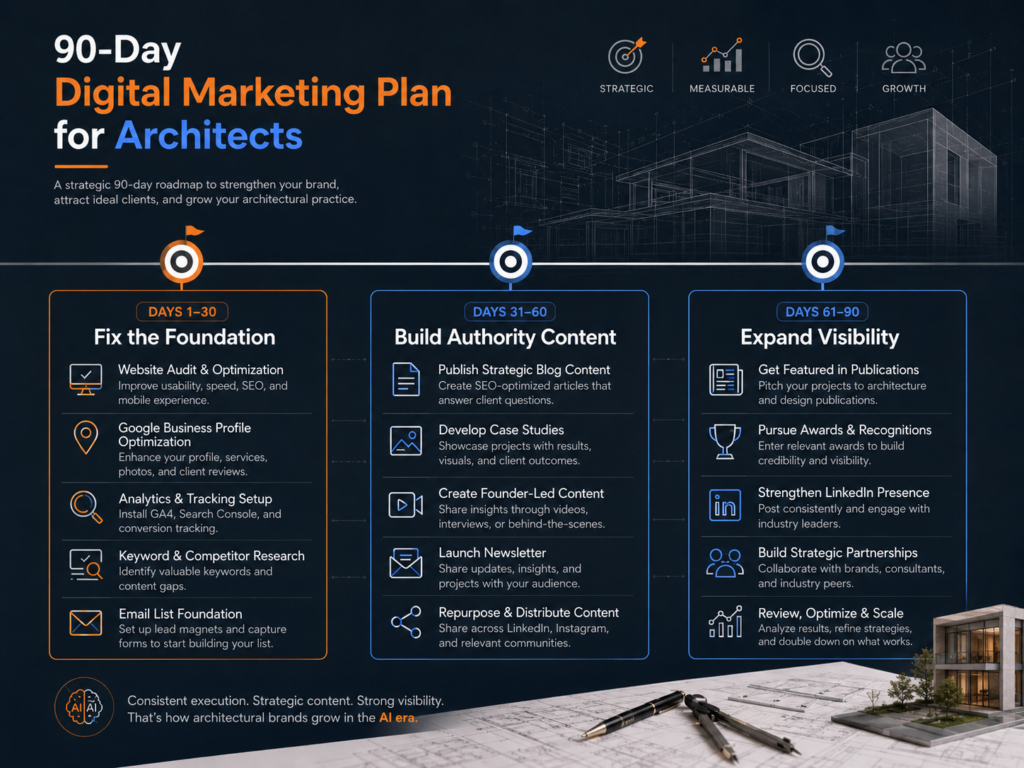
A firm without a strong digital presence should not try to do everything at once. The best approach is to build the foundation first, then add channels in the right order.
Days 1-30: Fix the Foundation
Start with the website, Google Business Profile, and tracking.
Key actions:
- Audit the website structure
- Improve mobile speed and Core Web Vitals
- Compress and optimize portfolio images
- Add clear calls to action
- Create or improve service pages
- Optimize Google Business Profile
- Add project photos and services
- Set up form and phone click tracking
- Add basic schema markup
Days 31-60: Build Authority Content
Once the foundation is stronger, begin publishing content that proves expertise.
Key actions:
- Publish detailed case studies
- Create educational blog content
- Add FAQs to service pages
- Build location-focused content
- Repurpose case studies into social posts
- Start founder-led short videos
- Collect and publish testimonials
Days 61-90: Expand Visibility
After the core content is live, begin expanding reach through platforms and authority channels.
Key actions:
- Build or improve Houzz profile for residential work
- Strengthen LinkedIn presence for commercial work
- Launch a monthly email newsletter
- Submit projects to publications
- Apply for relevant awards
- Review analytics and lead quality
- Adjust channel focus based on inquiries
This sequence helps architecture firms avoid scattered marketing. It creates a practical system in which every channel supports the same goal: better-qualified project inquiries.
How to Measure Architecture Marketing Performance
Many architecture firms measure the wrong numbers. Follower count, impressions, and website visits can be useful, but they do not always show business impact.
The most important marketing metrics for architects are:
- Qualified inquiries per month
- Consultation requests
- Phone calls from organic search
- Form submissions by service page
- Average project value by source
- Cost per qualified lead
- Website conversion rate
- Google Business Profile actions
- Case study traffic
- Email replies and referrals
- Pipeline value from digital channels
The key is to track quality, not just quantity. Ten weak inquiries are less valuable than two serious project leads with the right budget, location, and timeline.
The Bottom Line on Digital Marketing for Architects
Digital marketing for architects works best when it is treated as a structured business system rather than a collection of random posts. A strong website, clear positioning, local SEO, case studies, reviews, platform-specific content, email marketing, and PR all work together to build trust before the first conversation.
The firms that will win better clients in 2026 are not only the ones with beautiful projects. They are the ones whose expertise is visible, credible, well-documented, and easy to find when the right client starts searching.
Request Digital Marketing Services for Your Architecture Firm
A strong online presence can help your architecture firm attract better clients, build trust before the first consultation, and turn your website into a reliable source of qualified inquiries. Whether your firm needs SEO, website design, content marketing, social media strategy, paid advertising, or complete digital growth support, having the right marketing system can make your services easier to find and easier to choose.
At Webix Solutions, we help businesses build stronger visibility through strategic digital marketing, SEO-focused website development, content planning, paid campaigns, and conversion-focused online growth strategies. If your architecture firm is ready to improve its website, rank for the right keywords, showcase projects more effectively, and generate better leads, our team can help you build a clear plan.
Request a service today and let Webix Solutions help your architecture firm grow with a smarter digital marketing strategy.
Frequently Asked Questions
What is digital marketing for architects?
Digital marketing for architects is the use of online channels such as websites, SEO, Google Business Profile, Houzz, Instagram, LinkedIn, email, content marketing, and PR to attract and convert project inquiries. It helps architecture firms become visible to the right clients before the first consultation.
Is digital marketing worth it for a small architecture firm?
Yes. Small architecture firms can compete effectively by targeting specific services, locations, and project types. A small firm with strong local SEO, a clear website, quality case studies, and good reviews can often compete against larger firms in niche markets.
How long does SEO take for architects?
Most architecture firms should expect SEO to take several months. Competitive markets usually require consistent content, technical SEO, and authority building.
Is Houzz still useful for architects?
Houzz can still be useful for residential architects, interior architects, renovation specialists, and custom home firms. It works best when the profile includes strong project photography, detailed descriptions, reviews, ideabooks, and complete business information.
What type of content should architects publish?
Architects should publish case studies, project stories, educational guides, explanations of the design process, FAQs, local project insights, and short videos. The goal is to help clients understand the firm’s expertise, process, and results.
How much should architecture firms spend on digital marketing?
The budget depends on the firm’s size, goals, location, and growth stage. Newer firms may need to invest more in website improvement, SEO, and content creation. Established firms may focus more on authority building, PR, email, and conversion optimization.