
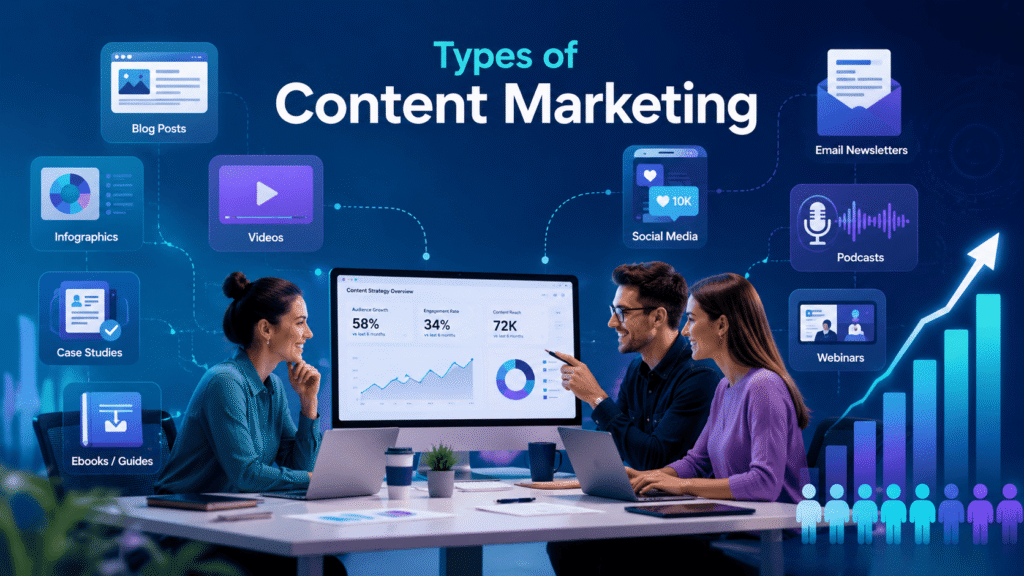
The most effective types of content marketing to grow your audience include blog posts, videos, social media content, email newsletters, infographics, case studies, ebooks, whitepapers, podcasts, webinars, interactive tools and user-generated content. Each format supports a different purpose. Some attract new visitors through search, while others build trust, capture leads or encourage existing customers to return.
A successful content strategy rarely depends on one format alone. A business may use SEO blog posts to answer customer questions, short videos to increase visibility and email content to maintain the relationship. The right combination depends on the audience, marketing goal, available resources and stage of the customer journey.
The following content marketing examples explain how each format works, where it performs best and how it can contribute to sustainable audience growth.
Types of Content Marketing at a Glance
| Content type | Best used for | Primary benefit |
|---|---|---|
| Blog posts | Search visibility and education | Attracts organic traffic |
| Videos | Demonstrations and storytelling | Increases attention and retention |
| Social media content | Awareness and community building | Creates regular brand visibility |
| Email newsletters | Nurturing subscribers | Builds repeat engagement |
| Infographics | Data and process explanations | Makes information easier to understand |
| Case studies | Commercial decision-making | Provides evidence and social proof |
| Ebooks and guides | Lead generation | Captures contact information |
| Whitepapers | B2B authority | Demonstrates expertise |
| Podcasts | Long-form conversations | Builds familiarity and trust |
| Webinars | Education and live interaction | Generates engaged leads |
| Interactive content | Personalised engagement | Encourages participation |
| User-generated content | Trust and community proof | Shows authentic customer experience |
1. Blog Posts That Answer Search Intent
Blog posts are among the most valuable written content marketing formats because they can answer questions people are already searching for. A well-planned article can attract organic traffic, explain a service and guide readers towards a relevant next step.
Effective blog content is usually based on a specific search intent. Informational articles may answer questions, explain a process or compare options. Commercial articles can help readers evaluate services, costs or solutions before making a decision.
Strong blog posts should include:
- A clear answer near the beginning
- Logical H2 and H3 headings
- Original examples or professional observations
- Relevant internal links
- Descriptive image alt text
- A useful next step or call to action
Rather than publishing unrelated articles, businesses can organise posts into topic clusters. This allows several supporting articles to strengthen one comprehensive pillar page.
2. Video Content That Earns Attention Quickly
Video combines visuals, sound and human expression, making it useful for subjects that are difficult to communicate through text alone. Product demonstrations, tutorials, interviews, customer stories and behind-the-scenes videos can all help a brand become more understandable and memorable.
Longer educational videos may perform well on a website or video platform, while shorter clips can be adapted for social feeds. The format should match the viewer’s expectations on each channel.
Useful video marketing practices include:
- Opening with a clear hook
- Focusing each video on one main message
- Adding captions for accessibility
- Using descriptive titles and summaries
- Including a relevant next step
- Turning longer recordings into shorter clips
High production quality can help, but clarity is more important than expensive equipment. A well-explained solution recorded with clear audio can provide more value than a highly polished video with no useful message.
3. Social Media Content That Builds Daily Visibility

Social media content allows businesses to communicate frequently without producing a full article or video for every update. Short posts, carousels, Stories, Reels, polls and question-and-answer sessions can keep a brand visible between larger campaigns.
However, the same post should not simply be copied across every platform. A professional insight may work as a written LinkedIn post, while the same idea might become a visual carousel on Instagram or a short demonstration on TikTok.
Social content can be organised around a few repeatable themes:
- Educational advice
- Industry opinions
- Customer questions
- Company updates
- Product demonstrations
- Employee or founder insights
- Customer success stories
The objective should be meaningful interaction rather than empty posting frequency. Comments, saves, shares, profile visits and website clicks often reveal more than basic impression counts.
4. Email Newsletters That Create Repeat Engagement
Email marketing gives a business a direct way to reach people who have already shown interest. Unlike an audience built entirely on a third-party platform, an email list can support ongoing communication with prospects and customers.
A useful newsletter does not need to be long. It may include one practical insight, a recent article, a customer story or an invitation to an upcoming event. What matters is that subscribers receive a clear reason to open future messages.
Businesses can improve email content by:
- Segmenting subscribers according to interests
- Writing specific subject lines
- Keeping each email focused
- Linking to deeper website resources
- Removing unnecessary promotional language
- Using automated sequences for new subscribers
Email becomes particularly powerful when it connects other digital content types. A new guide, webinar, article or case study can all be distributed through a relevant email campaign.
5. Infographics That Simplify Complex Information
Infographics turn statistics, comparisons, timelines and processes into visual stories. They are particularly useful when readers need to understand several related points quickly.
Common infographic formats include:
- Step-by-step processes
- Side-by-side comparisons
- Industry statistics
- Timelines
- Checklists
- Decision trees
- Geographic data
An effective infographic should follow a clear reading order. The copy must remain concise, the data should come from reliable sources and the design should support the information rather than compete with it.
Infographics can be published within blog posts, shared on social platforms, added to presentations or divided into smaller visual assets. When supported by original data, they may also attract citations and backlinks from other websites.
6. Case Studies That Prove Real Results

Case studies demonstrate how a product or service solved a genuine problem. They are especially valuable for readers who understand an offer but still need evidence before making a decision.
A credible case study normally follows four stages:
- The customer’s situation
- The original problem or objective
- The solution and implementation process
- The measurable result
Specific evidence makes a case study more convincing. Verified improvements in traffic, enquiries, revenue, conversion rate or operating efficiency are stronger than broad claims such as “the campaign was successful.”
Real customer quotations, screenshots and before-and-after comparisons can add further credibility. Results should be presented accurately, with enough context to avoid creating misleading expectations.
7. Ebooks and Guides That Capture Qualified Leads
Ebooks are longer educational resources that explore a topic in greater depth than a standard article. They are often offered in exchange for an email address, making them useful for lead generation.
A good ebook focuses on a meaningful problem rather than combining generic information into a lengthy PDF. It should offer structured guidance, original insight and a clear outcome.
Suitable ebook topics include:
- Complete beginner guides
- Implementation frameworks
- Industry checklists
- Planning templates
- Buyer guides
- Collections of related expert advice
A focused landing page should explain who the resource is for, what it covers and why it is useful. Form fields should be limited to the information the business genuinely needs.
8. Whitepapers and Original Research That Build Authority
Whitepapers are research-led documents created for readers who require detailed evidence before making a strategic or technical decision. They are especially relevant in B2B industries, professional services and sectors involving complex products.
Unlike a general ebook, a whitepaper normally includes:
- An executive summary
- Industry context
- Research methodology
- Key findings
- Supporting charts or tables
- Practical recommendations
- Limitations of the research
Original surveys, internal data and expert analysis can make this content particularly authoritative. Clear methodology is essential. Readers should understand where the information came from and how conclusions were reached.
Whitepapers can support media outreach, sales conversations, email campaigns and professional networking. Smaller insights from the report can also be repurposed into articles, graphics and social posts.
9. Podcasts That Build Familiarity Through Voice
Podcasts allow audiences to consume content while travelling, exercising or completing other tasks. The conversational format can make specialists, founders and team members feel more accessible.
Common podcast formats include:
- Expert interviews
- Industry discussions
- Customer stories
- Solo educational episodes
- Question-and-answer sessions
- News and trend analysis
Consistency matters more than producing an excessive number of episodes. Each episode should serve a defined audience and address a recognisable subject.
Publishing transcripts and detailed episode summaries can improve accessibility and make podcast content easier for search engines to understand. Short audio or video excerpts can then be shared through social channels to attract new listeners.
10. Webinars That Educate and Generate Leads
Webinars combine detailed education with direct audience interaction. They can be used for live demonstrations, training sessions, expert panels, product walkthroughs or discussions about industry changes.
Because attendees register in advance, webinars can attract prospects with a stronger level of interest than casual social media viewers. The session should still provide genuine value rather than becoming an extended sales pitch.
A practical webinar structure includes:
- A clearly defined topic
- A brief introduction
- Three or four main teaching points
- Supporting examples
- A live question session
- A relevant next step
Recorded sessions can continue providing value after the live event. They may be turned into on-demand videos, blog posts, short clips, email lessons or downloadable summaries.
11. Interactive Content That Encourages Participation
Interactive content asks the user to take an action rather than passively read or watch. Calculators, quizzes, assessments, configurators, polls and interactive checklists can create a more personalised experience.
For example, a financial company might offer a cost calculator, while a marketing agency could provide a website performance assessment. The result gives the visitor immediate value while helping the business understand the visitor’s needs.
Interactive tools work best when they:
- Solve a real problem
- Require minimal effort
- Produce an immediate result
- Work properly on mobile devices
- Avoid requesting unnecessary personal information
- Offer an appropriate next step
This format can generate strong engagement because the experience is shaped by the user’s own inputs.
12. User-Generated Content That Adds Authentic Proof

User-generated content includes reviews, customer photos, social posts, testimonials, community discussions and other material created by customers rather than the business itself.
This format can strengthen trust because potential buyers are often interested in how real people use a product or experience a service. It can also help existing customers feel connected to the brand.
Businesses can encourage user-generated content through:
- Review requests
- Branded campaigns
- Customer spotlights
- Community questions
- Photo submissions
- Post-purchase emails
Permission should be obtained before republishing customer material. Sponsored or incentivised submissions should also be identified clearly to maintain transparency.
How to Choose the Right Content Marketing Formats
The best content type is determined by the goal rather than popularity.
A business seeking search visibility may prioritise blog posts and original research. A company selling a visual product may benefit more from demonstrations, customer photos and short videos. A B2B service with a longer decision process may need whitepapers, webinars, email nurturing and detailed case studies.
The decision should consider five factors:
Audience behaviour
The content must reflect where the intended audience searches, learns and communicates.
Marketing objective
Brand awareness, lead generation, sales support and customer retention require different formats.
Available expertise
A smaller team may achieve more with two consistently produced formats than with six poorly maintained channels.
Distribution plan
Every asset needs a realistic path to discovery. Publishing alone does not create an audience.
Measurement method
The business should identify the intended result before production begins.
How One Idea Can Become Multiple Content Assets
A strong content strategy does not require a completely new idea for every channel. One original piece of research could become:
- A detailed website article
- An infographic
- A webinar
- Several social media posts
- A podcast discussion
- A downloadable report
- An email series
- Short educational videos
This approach is known as content repurposing. It helps a business reach people with different content preferences while maintaining a consistent message.
Repurposing should involve adapting the material, not copying it without change. A social post needs a faster opening than a whitepaper, while a video requires visual explanation rather than paragraphs read aloud.
Content Marketing Metrics Worth Tracking
Audience growth should be measured with indicators connected to the purpose of each format.
Relevant metrics may include:
- Organic search traffic
- Keyword visibility
- Returning visitors
- Email subscriptions
- Video watch time
- Social shares and saves
- Webinar registrations
- Resource downloads
- Qualified leads
- Conversion rate
- Customer retention
- Revenue influenced by content
A large number of views does not always represent success. A detailed case study that attracts twenty qualified decision-makers may be more valuable than a general social post receiving thousands of passive impressions.
Build a Content Mix That Supports Long-Term Growth
The most effective types of content marketing to grow an audience are those that answer real questions, demonstrate genuine expertise and give people a reason to return. A business does not need to produce every format at once. It needs a focused content mix connected to audience needs and measurable goals.
Blog posts can establish search visibility, videos can make ideas easier to understand, case studies can reduce uncertainty and email content can maintain the relationship. When these formats support one another, content marketing becomes more than a publishing schedule and it becomes a reliable system for attracting, educating and converting the right audience.
Need a content strategy that turns attention into leads? Webix Solutions creates SEO-focused content and digital marketing campaigns built around your business goals.
Frequently Asked Questions
What are the four main forms of content marketing?
The four broad forms are written content, visual content, video content and audio content. Interactive content is also commonly treated as a separate category because it requires active user participation.
Which content marketing type is best for audience growth?
No single format works for every business. Blog content is effective for search visibility, social media supports frequent discovery, video can increase engagement and email helps turn new visitors into a returning audience.
What is the best content type for a small business?
A small business can often begin with search-focused blog posts, email newsletters and one social platform where its audience is already active. Additional formats can be introduced as resources and audience data increase.
Is social media a form of content marketing?
Yes. Social posts, carousels, Stories, Reels, live broadcasts and community discussions are all forms of short-form content marketing.
How often should a business publish content?
Publishing frequency should be based on quality, resources and audience expectations. A consistent schedule of valuable content is more effective than frequent publishing that provides little original information.